The job of a MISO grid operator is a lot like that of an air traffic controller.
Air traffic controllers don’t own the airplanes, the runways, or the airports. But they’re responsible for safely and reliably guiding planes from point A to point B, 24/7/365.
MISO plays a similar role, but instead of planes, we manage the movement of electricity. From where it’s generated to where it’s needed—your local utility.
We don’t own power plants. We don’t own transmission lines. We don’t own any part of the electric grid.
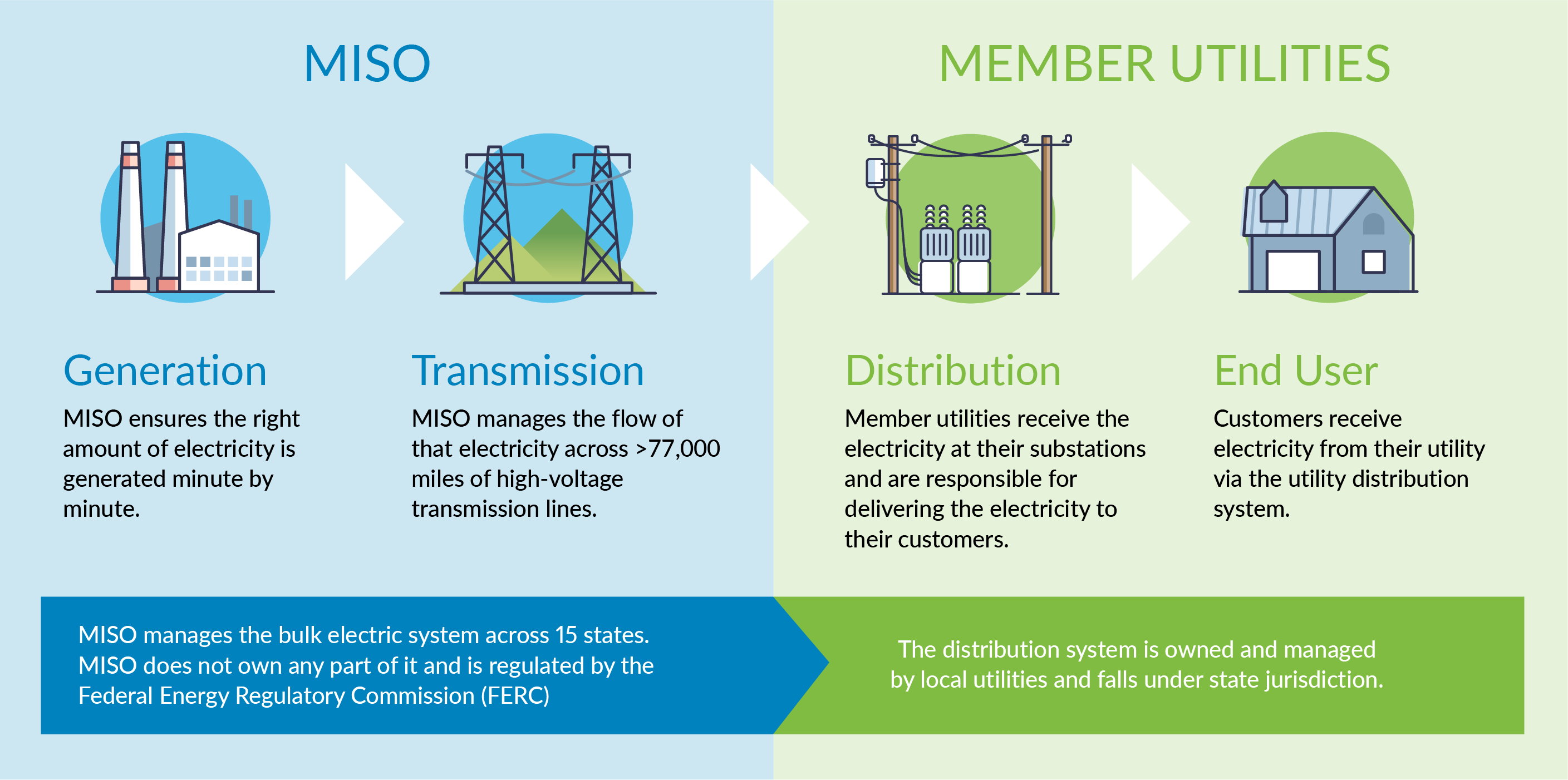
Our job is to make sure the right amount of electricity is generated and transmitted to our member utilities reliably and at the lowest possible cost. Then, your utility takes it from there, delivering that power to homes and businesses like yours.
The graphic shows how MISO and its member utilities work together to keep electricity flowing across our 15-state region.
Understanding Power Grid Outages
Let’s go back to the air traffic control analogy.
When a plane breaks down, flights get canceled and passengers are delayed. While the airline fixes the issue, air traffic controllers keep as many other planes moving as possible.
But sometimes, rare and extreme conditions force air traffic controllers to ground large numbers of planes—for safety.
The same is true on the electric grid. Generators can fail. Transmission lines can go down. When that happens, the equipment owners work to fix the problem, and MISO operators do everything possible to keep electricity flowing to the greatest number of people.
In rare and extreme cases, when electricity supply can’t meet demand, MISO may need to implement controlled power interruptions. If that happens:
- MISO determines how much electricity needs to be reduced
- MISO identifies which utilities will need to reduce usage
- Then, each utility decides which customers will temporarily lose power and carries out the interruption
Just like grounding planes, these controlled outages are always a last resort. They’re used to protect the grid from damage and to keep power flowing to as many people as possible.